





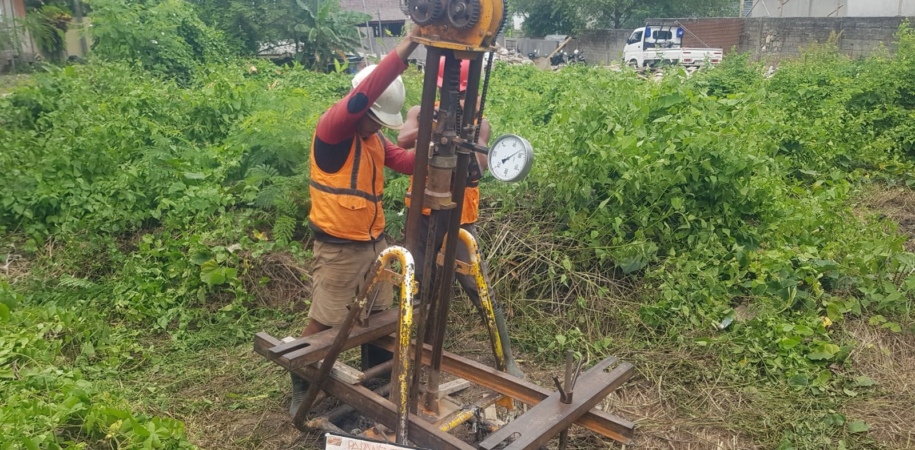

The CPT test Bali procedure is one of the most efficient and widely recognised in-situ geotechnical methods available to engineers and developers today. Despite its widespread use across construction projects in Bali, NTB, and NTT, many landowners and developers still lack a clear understanding of what the Cone Penetration Test actually measures, how the equipment works, and when it should be recommended over other methods.
This guide breaks down the full CPT test Bali procedure from start to finish. Whether you are planning a villa, a resort, or a commercial structure, understanding how CPT works will help you make better decisions about your ground investigation programme and, ultimately, your foundation design.
What Is CPT (Cone Penetration Test)?
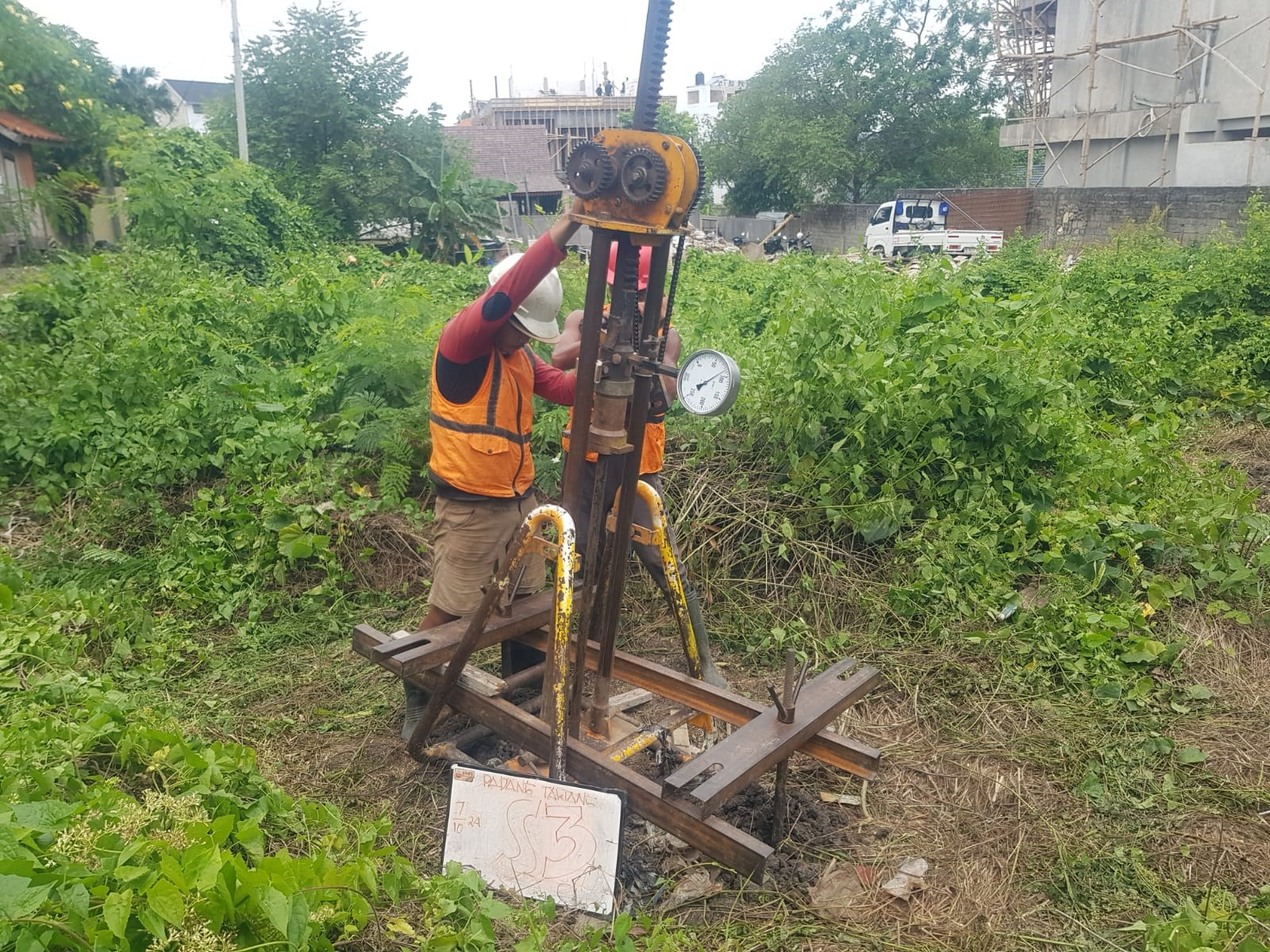
The Cone Penetration Test, commonly abbreviated as CPT or referred to locally as Sondir, is a hydraulic pressure-based field test in which a calibrated cone is pushed steadily into the ground. The cone measures two primary parameters simultaneously: tip resistance (qc), which is the force required to push the cone tip through each soil layer, and sleeve friction (fs), which is the resistance measured along a cylindrical sleeve just above the cone tip.
According to ASTM D5778, the internationally recognised standard for electronic friction cone and piezocone penetration testing, tests performed using this method provide a detailed and continuous record of cone tip resistance useful for evaluating site stratigraphy, engineering properties, and depth to firm layers. This continuity of data is one of the key advantages that sets the CPT apart from other field testing methods.
The international standard ISO 22476-1:2022 further defines the CPT as covering both the electrical cone penetration test and the piezocone test (CPTu), the latter also measuring pore water pressure during penetration. Together, these two subcategories provide a highly comprehensive picture of subsurface conditions without requiring any drilling or soil sampling.
How the CPT Sondir Equipment Works
The CPT equipment consists of a cone penetrometer attached to a series of steel rods, all connected to a hydraulic thrust system mounted on a vehicle or static frame. The cone itself contains electronic load cells and, in piezocone configurations, a pore pressure transducer that feeds data in real time to a data acquisition unit on the surface.
The penetrometer is pushed into the ground at a constant rate of 20 millimetres per second, as specified by both ASTM D5778 and ISO 22476-1:2022. This standardised penetration rate ensures that results are consistent, comparable, and reproducible across different sites and operators. At every centimetre of depth, the sensors record tip resistance, sleeve friction, and where applicable, pore water pressure.
The ISSMGE Technical Committee TC102 on In-Situ Testing recognises CPT as one of the most continuously advanced field testing methods in geotechnical engineering, with ongoing development in equipment precision, data resolution, and multi-sensor integration. Indo Soil uses modern digital data acquisition systems that record measurements at the highest available resolution, ensuring accurate interpretation of even thin or transitional soil layers.
Testing Depth and Capacity
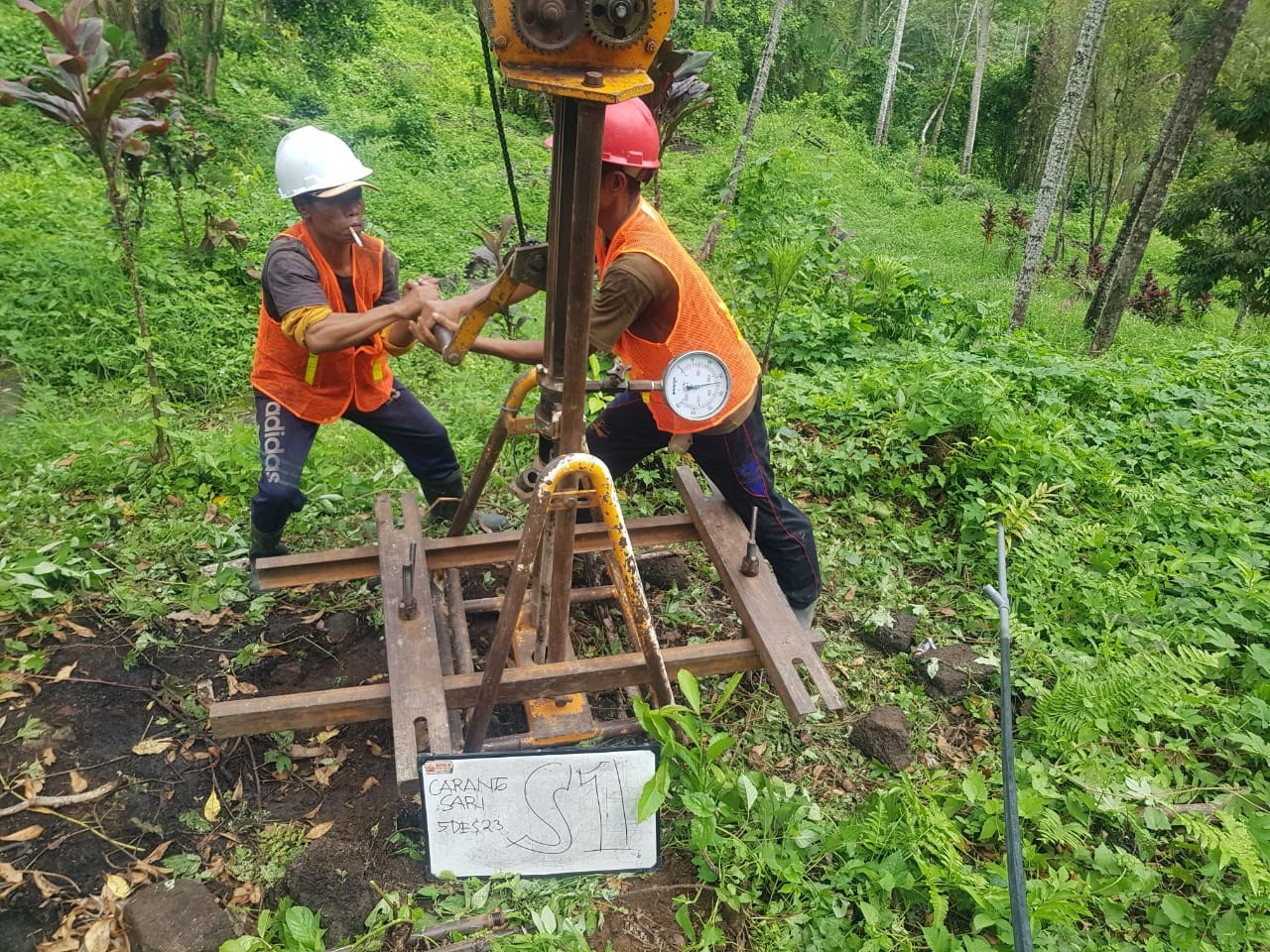
The depth that a CPT can achieve depends on the thrust capacity of the equipment and the resistance of the soil being penetrated. Standard CPT rigs provide thrust forces typically ranging from 10 to 20 tonnes, which are sufficient for most residential and light commercial construction sites in Bali. According to ASTM D6067, typical depths achieved with standard equipment range from 20 to 40 metres, while heavier rigs exceeding 20 tonnes can reach depths of 70 metres or more.
In practice, the CPT test Bali procedure commonly targets depths of between 5 and 20 metres for most villa and low-rise commercial projects. Testing can be stopped at any depth once the cone encounters a refusal condition, meaning the soil resistance exceeds the thrust capacity of the equipment. This refusal point itself provides useful engineering data, as it typically indicates the presence of dense sand, gravel, or rock.
For sites in Bali where deep, soft alluvial soils are present such as coastal Canggu, Seminyak, and parts of Denpasar, the CPT provides an uninterrupted profile from the surface down to firm bearing layers, which is critical for accurate pile length design.
Advantages of CPT Over Other Methods
The CPT test Bali procedure offers several clear advantages over conventional drilling-based methods such as the Standard Penetration Test. Importantly, these advantages make CPT the preferred method for a wide range of project types and site conditions across tropical environments like Bali.
| Feature | CPT / Sondir | SPT Boring |
|---|---|---|
| Data continuity | Continuous measurement every 1 cm of depth | Discrete readings every 1.5 m interval |
| Speed of testing | Fast, typically 1 to 3 hours per sounding | Slower, drilling required per borehole |
| Soil disturbance | Minimal, no drilling or sampling required | Moderate, borehole drilling disturbs soil profile |
| Data quality | High resolution, operator-independent readings | Results sensitive to hammer energy and operator technique |
| Soil sample collection | Not available during standard CPT | Physical samples available for lab analysis |
| Ideal application | Soft to medium soils, stratification profiling | Deep profiling, hard soil layers, laboratory testing |
| Cost efficiency | Lower cost per test point | Higher cost due to drilling equipment and time |
As confirmed by ASTM D5778-20, CPT tests the soil fully in situ without obtaining samples, which eliminates disturbance effects and provides a more reliable continuous record of subsurface variability. Furthermore, the standardised push rate removes operator-dependent variability that commonly affects SPT results.
Unsure whether CPT or SPT is the right method for your project? Get a free recommendation from Indo Soil’s geotechnical team today.
When Is CPT Recommended?
The CPT test Bali procedure is most suitable when you need a fast, high-resolution soil profile across multiple test points at a site. Specifically, it is the recommended method for projects where the primary goal is to determine soil stratification, identify bearing layers, and estimate foundation depth without needing physical soil samples for laboratory classification.
CPT is particularly well-suited to the following project types and site conditions in Bali:
Villa and residential development on flat to gently sloping terrain where soft to medium soils are expected. Boutique resort construction on coastal land where accurate depth-to-bearing-layer data is critical for pile design. Feasibility investigations where a large number of test points across a site are needed rapidly and cost-effectively. Sites with complex stratigraphy where thin layers of soft material between stiffer layers must be identified, as CPT captures these transitions at centimetre resolution.
However, for sites where very dense soil or rock refusal is expected at shallow depths, or where physical soil samples are required for laboratory classification under standards such as Eurocode 7 (EN 1997), an SPT boring programme may be more appropriate. Indo Soil recommends the most suitable investigation method only after reviewing your specific site conditions and project requirements.
CPT Data Output and Interpretation
The raw output of a CPT test Bali procedure consists of a continuous depth profile of tip resistance (qc), sleeve friction (fs), and friction ratio (Rf). These three parameters, plotted against depth, form the primary CPT sounding log. In piezocone tests, pore water pressure (u2) is added as a fourth parameter, providing additional information on drainage conditions, consolidation characteristics, and the presence of permeable or impermeable layers.
| CPT Parameter | Symbol | What It Tells You | Unit |
|---|---|---|---|
| Cone tip resistance | qc | Soil strength and density at each depth increment | MPa |
| Sleeve friction | fs | Frictional resistance of surrounding soil on the sleeve | kPa |
| Friction ratio | Rf = fs/qc x 100% | Used for soil classification and behavior type charts | % |
| Pore water pressure (CPTu) | u2 | Drainage conditions, consolidation rate, permeability | kPa |
| Corrected tip resistance | qt | Adjusted qc for pore pressure effects in fine-grained soils | MPa |
From these parameters, Indo Soil’s geotechnical engineers derive key engineering outputs including soil classification using Robertson’s Soil Behaviour Type charts, bearing capacity estimates for shallow and deep foundations, pile length recommendations, and liquefaction susceptibility assessments where relevant. The ISSMGE’s introduction to CPT emphasises that CPT data interpretation must consider the specific soil behaviour at each site, particularly in tropical and volcanic soil environments where mineralogy can influence friction ratio readings.
Each CPT sounding produced by Indo Soil is accompanied by a certified technical report in both English and Indonesian. The report includes all raw data logs, interpreted soil profiles, bearing capacity values, and foundation recommendations. This dual-language format makes reports directly usable for SLF and PBG permit submissions as well as for review by international structural engineers and architects.
CPT Test Service Packages and Pricing
Indo Soil offers transparent, fixed-price packages for CPT and all other geotechnical services. Every package includes professional field testing by experienced engineers, digital data acquisition, and a certified technical report delivered within 5 to 7 working days. There are no hidden charges and no surprises.
| Package | Price (IDR) | What Is Included | Best For |
|---|---|---|---|
| Basic Soil Test (CPT) | Rp 4,000,000 | 3 CPT / Sondir test points (0 to 5 m depth), site visit, PDF certified report in English and Indonesian, initial foundation recommendation | Small villas, early feasibility assessment, shallow foundation planning |
| Business Starter Package | Rp 7,500,000 | Topographic survey with contour lines and cross-sections, 3 CPT test points (0 to 5 m), full bilingual technical report, PDF and CAD (DWG) output | Mid-size residential, boutique commercial, resort developments |
| Topographic Survey | Rp 4,500,000 | Elevation survey via GPS or Total Station, DWG and PDF output, spot levels and benchmark points, suitable for cut-and-fill and drainage planning | Land planning prior to construction, drainage and layout design |
For larger sites, cliff-top projects, or investigations requiring SPT boring at depths exceeding 5 metres, Indo Soil provides custom quotations based on the specific number of test points, target depth, and site accessibility. Contact the team for a project-specific estimate at no obligation.
CPT Test Services in Bali by Indo Soil
Indo Soil is Bali’s specialist geotechnical investigation company with over 10 years of active field experience and more than 100 completed projects across Bali, NTB, and NTT. The team conducts all CPT test Bali procedures using calibrated electronic cone penetrometers aligned with ASTM D5778-20 and ISO 22476-1:2022. Every investigation is executed by qualified geotechnical engineers with direct field experience across Bali’s highly variable soil conditions.
Indo Soil serves clients across all major districts in Bali including Badung, Denpasar, Gianyar, Tabanan, Buleleng, and Karangasem. The company also operates across Lombok and Sumbawa in NTB and across key project areas in NTT. Reports are structured to meet the reporting requirements outlined in Eurocode 7 (EN 1997-2) for ground investigation reporting, making them fully usable by both local and international engineering consultants.
With a track record across villa developments, cliff-top resorts, coastal properties, and government infrastructure, Indo Soil brings the technical depth and practical experience to handle every site condition Bali presents. Results are delivered in 5 to 7 working days, certified and ready for permit submission.
Ready to schedule your CPT test in Bali? Contact Indo Soil today for a free consultation and a quote tailored to your project.
Conclusion
The CPT test Bali procedure is one of the most reliable, cost-effective, and data-rich geotechnical investigation methods available to developers and engineers working in Bali. From its standardised push rate and continuous data recording to its rapid field execution and comprehensive report output, CPT provides everything you need to make confident foundation decisions.
Understanding how CPT works, what it measures, and when it is the right choice for your project is an essential part of responsible construction planning in a geologically complex environment like Bali. Indo Soil is ready to carry out your CPT investigation with professional equipment, certified reporting, and expert interpretation. Contact us today and build your project on facts, not assumptions.
Contact Indo Soil: +62 851 3514 2186 | admin@soiltestbali.com
Frequently Asked Questions
1. What does the CPT test Bali procedure actually measure?
The CPT test measures tip resistance (qc), sleeve friction (fs), and friction ratio (Rf) continuously as the cone is pushed into the ground at a standard rate of 20 mm per second. In piezocone configurations, pore water pressure (u2) is also measured. These parameters allow engineers to classify soil types, estimate bearing capacity, and recommend appropriate foundation systems.
2. How long does a CPT test take on site in Bali?
A single CPT sounding to a depth of 5 to 10 metres typically takes between 30 minutes and 2 hours to complete, depending on the soil conditions and depth achieved. Multiple soundings can be completed in a single day. The certified technical report is then delivered within 5 to 7 working days.
3. Is CPT suitable for cliff-top or sloping sites in Bali?
Yes, with appropriate equipment positioning and safety planning. For steep cliff-top sites in areas like Uluwatu and Pecatu, Indo Soil assesses site accessibility before testing and recommends the most appropriate combination of methods. In some cases, CPT is supplemented with SPT boring or hand auger investigation for elevated or restricted access locations.
4. Can the CPT report be used for SLF and PBG permit applications in Bali?
Yes. All Indo Soil CPT reports are certified and prepared in both English and Indonesian, following a format consistent with Indonesian National Standard SNI 2827:2008 and international reporting guidelines under Eurocode 7. This makes the reports directly suitable for submission to local building permit authorities as well as for review by international architects and structural engineers.
5. What is the difference between CPT and the Sondir test commonly mentioned in Indonesia?
Sondir is the locally used Indonesian term for the Cone Penetration Test. The name originates from the Dutch word for sounding and refers to the same test procedure. The mechanical version was originally standardised in the Netherlands and remains widely used under the name Sondir in Indonesia. The electronic version, which provides higher data resolution and additional pore pressure measurement, corresponds to ASTM D5778 and ISO 22476-1 and is what Indo Soil primarily uses for all current project investigations.
